Ask a buyer where a Plum Island cottage sits and nearly everyone gives the same answer: Plum Island. Ask which town cashes the tax check, which school district the address feeds into, or whether the toilet runs to a municipal line or a private tank in the yard, and the answer changes depending on which side of an invisible boundary the house happens to sit on. Those boundaries do not show up in a portal search. They show up on the closing statement.
Plum Island is an 11-mile barrier island, and the developed northern stretch that buyers actually compare listings against is split across four separate municipalities: Newburyport, Newbury, Rowley, and Ipswich. Two houses a few blocks apart can carry different tax rates, feed different school systems, and rely on entirely different water and waste infrastructure. Anyone comparing "Plum Island" against another North Shore neighborhood is really comparing four smaller markets that happen to share a beach.
One Island, Four Landlords
The island was never its own town. In 1649 the Massachusetts General Court divided it among three colonial settlements, granting roughly two-fifths each to Newbury and Ipswich and one-fifth to Rowley. When Newburyport broke off and incorporated in 1851, it carved a fourth piece out of Newbury's share, and that four-way split is still exactly how the island is taxed and governed today.
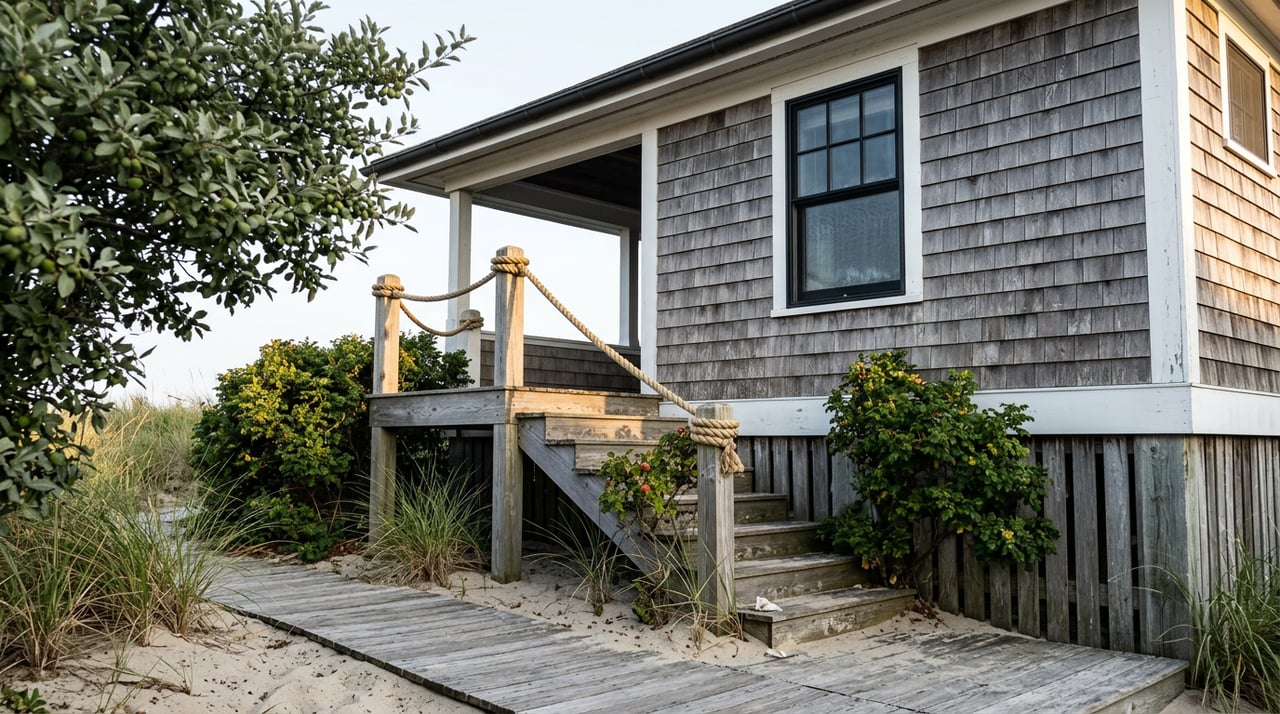
For most of its history the island stayed agricultural, used for grazing and salt-hay harvesting. A turnpike and bridge completed in 1807 opened it to regular travel, and after a run of 19th-century shipwrecks led to the founding of one of the nation's first U.S. Life-Saving Stations in 1874, the character of the place started shifting toward recreation. The real turn came in the 1920s, when the Plum Island Beach Company bought up the Newbury section, laid out Northern Boulevard, ran in electricity, and began selling cottage lots. That build-out is why the shingled, close-set summer cottages along Northern Boulevard still look the way they do a century later.
The point for a buyer today is not the history lesson. It is that the island's governance was set by a 17th-century land grant, not by anything resembling a modern planning process, and every practical detail of ownership still traces back to that original split.
The Tax Bill Depends on Where the Line Falls
Massachusetts towns each set their own residential rate, and the four towns that share Plum Island are not close to each other. Here is where FY2026 rates stand:
| Town | FY2026 residential rate (per $1,000 assessed value) |
|---|---|
| Newbury | $7.51 |
| Newburyport | $9.26 |
| Ipswich | $10.78 |
| Rowley | $12.09 |
On a home assessed at $1.3 million, roughly the median list price recent local listing aggregations have shown for the island, that spread is not academic. At Newbury's rate, the annual bill runs close to $9,760. At Rowley's rate, the same assessed value produces a bill closer to $15,720. That is nearly a $6,000 annual difference for what could be a structurally identical house, driven entirely by which town's line the lot falls inside. A buyer comparing two listings with similar asking prices needs to know which town collects before the comparison means anything.
Same Island, Three School Systems
School assignment follows the same fracture. A Plum Island address in the Newburyport section is zoned to Newburyport Public Schools, feeding Newburyport High School. Addresses in the Newbury and Rowley sections feed into Triton Regional Middle and High School, which Newbury and Rowley share with Salisbury, while each town runs its own elementary school. The Ipswich section is zoned to Ipswich Public Schools and Ipswich High School. None of this is a ranking of one system over another. It is simply a fact that "Plum Island schools" is not one answer, and confirming which district a specific address feeds is part of ordinary due diligence, not an afterthought.
The Sewer Line That Only Reaches Half the Island
This is the piece that actually catches buyers off guard mid-transaction. Water and sewer access on Plum Island is not a given based on the neighborhood. It varies lot by lot, and the two systems in play work very differently.
The Newburyport section runs on a municipal vacuum sewer system, operated by the city's Department of Public Works with Air-Vac equipment, that pulls waste from homes through underground vacuum pressure rather than gravity. It works well most of the year and struggles in hard winters. In February 2026, back-to-back snowstorms buried the system's air vents and froze sewer valves across the island, dropping vacuum pressure to the point that residents on the beach side and near the lighthouse were told to stop using water entirely. Because several homes share a single valve pit, one frozen valve could back wastewater into a neighbor's house rather than the owner's own. The city, the Governor's office, and MEMA coordinated temporary housing for more than fifty residents, with relocations beginning on February 23 to hotels in Amesbury, Haverhill, Danvers, and Seabrook, and the Red Cross setting up at PITA Hall on the island itself. That is not a one-year anomaly. It is the operating reality of a vacuum system laid under a barrier island, and it is worth understanding before you buy into it, not after the first hard freeze.
Elsewhere on the island, the picture flips entirely. Many homes in the Rowley, Ipswich, and non-connected Newbury sections rely on private wells and Title 5 septic systems rather than any municipal line. Ipswich goes further than the state's baseline Title 5 code: the town's Board of Health enforces stricter local septic standards because of shallow bedrock, fast-percolating soils, high groundwater tables, and fractured bedrock conditions that make standard state rules insufficient for protecting nearby wells and shellfish beds. In practice, that means septic inspections, upgrades, and variance requests in the Ipswich section can involve more paperwork and more conditions than a comparable system a few miles away.
Neither setup is better across the board. A house on municipal sewer avoids septic inspections and leach field maintenance but inherits a system with a documented cold-weather failure mode. A house on a private well and septic avoids that specific risk but carries its own inspection, maintenance, and, in Ipswich's case, added local regulatory layer. What matters is that a buyer cannot assume either answer from the listing photos. Confirming water and sewer status, town by town and lot by lot, has to happen before an offer goes in, not during the home inspection period.
What the Median Price Is Actually Averaging
Local listing aggregation for the Newburyport side of Plum Island put the median sale price at $919,680 as of June 2026, down 17.5 percent year over year. Other 2025 and 2026 reporting windows for the same stretch of island have shown medians ranging from roughly $1.1 million to $1.7 million, a spread that says more about a thin, seasonal sales sample than about any single fixed price point.
That variability is the tell. A single median for "Plum Island" is quietly averaging across four tax rates, three school systems, and two entirely different utility regimes, then reporting back one number as if it described one product. It does not. A buyer using that median to anchor an offer on a specific house needs to adjust for which town, which utility setup, and which school assignment that house actually carries, because the aggregate figure was never built to answer those questions in the first place.
Before writing an offer on Plum Island, it is worth confirming a short list directly with the listing agent or the relevant town office:
- Which of the four towns holds the tax roll and what the current residential rate is
- Whether the property is on municipal water and sewer or a private well and septic system, and if septic, when it last passed Title 5 inspection
- Which school district and specific schools the address is zoned for
- Whether any recent capital assessments or betterment charges apply to the parcel
Frequently Asked Questions
Is Plum Island on sewer or septic?
It depends on the section. The Newburyport portion runs on a municipal vacuum sewer system operated by the city. Much of the rest of the island, including sections in Rowley, Ipswich, and parts of Newbury, relies on private wells and Title 5-regulated septic systems. Confirming which applies to a specific address is a standard part of due diligence before purchase.
Will my kids attend Newburyport schools if I buy on Plum Island?
Only if the address falls in the Newburyport section. Homes in the Newbury and Rowley sections feed into Triton Regional Middle and High School, shared with Salisbury, and homes in the Ipswich section are zoned to Ipswich Public Schools. School assignment tracks the town line, not the island as a whole.
Why does the same house cost more in taxes depending on where it sits?
Because Plum Island spans four Massachusetts towns, and each town sets its own residential tax rate independently. As of FY2026, that rate runs from Newbury's $7.51 per $1,000 up to Rowley's $12.09 per $1,000, with Ipswich and Newburyport in between. Two similarly priced homes can carry meaningfully different annual tax bills based purely on which town's line they fall inside.
Plum Island rewards buyers who do their homework before falling for the view. If you are weighing a specific address against what its tax rate, school assignment, and utility setup actually mean for your budget and your day-to-day ownership experience, Kevin Fruh can walk through the specifics of that parcel, town by town, before you write an offer. Request Your Complimentary Home Valuation to start the conversation with real numbers instead of a blended median.